How Long Does Dwarkadhish Darshan Take? The Honest Season-by-Season Answer
Off-peak season (March–September, excluding Janmashtami): 45 minutes to 1.5 hours. Peak season (October–February, weekends): 2 to 4 hours. Dwarkadhish Temple has no official VIP darshan scheme, every pilgrim uses the same queue, so timing your visit well is the only real way to cut the wait. Here is every number you need, broken down by season.
Season-by-Season Darshan Wait Times at Dwarkadhish
The single most useful thing to know before visiting Dwarkadhish Temple is that queue time varies enormously by month and day. The same temple, the same deity, the same 56 steps, but the difference between a May Tuesday morning and a December Sunday morning is the difference between 45 minutes and nearly four hours. The table below gives realistic average wait times across the year, distinguishing weekday from weekend figures.
| Season / Period | Weekday Wait | Weekend Wait | Crowd Level |
|---|---|---|---|
| March – May (Low crowd) | 45 – 60 min | 1 – 1.5 hrs | Low |
| June – September (Moderate) | 1 – 1.5 hrs | 1.5 – 2 hrs | Moderate |
| Janmashtami (August) | 4 – 6+ hours regardless of day | Extreme | |
| October – November (Growing) | 1.5 – 2 hrs | 2 – 2.5 hrs | High |
| December – February (Peak) | 2 – 3 hrs | 2.5 – 4 hrs | Peak |
| Ekadashi & Purnima (any month) | +30–60 min extra | +1–2 hrs extra | Surge |
These figures represent total time from joining the queue at Swarga Dwar to exiting through Moksha Dwar, including the 56-step climb, movement through the inner courtyard and corridor, the darshan moment at the sanctum, and receiving charnamrit. Actual time at the sanctum, standing directly before the deity, is typically 10 to 15 seconds in the busiest periods and up to 3 to 5 minutes on a quiet morning.
March to May: Low Crowd, 45–60 Minutes
March through May represents the easiest visiting window from a queue perspective. The weather in Dwarka begins warming rapidly, April and May see temperatures of 36–42°C, which discourages all but the most committed pilgrims. That lower footfall translates directly into shorter queues. A weekday morning in April can see you through the complete darshan in 45 minutes.
The trade-off is heat. The 56 marble steps to Swarga Dwar are barefoot, marble retains heat, and by 10 AM in May, the steps are genuinely uncomfortable. The queue corridor inside is covered but not air-conditioned. Carry a water bottle (to be left at the locker before entering), wear light cotton clothing, and plan your darshan for the earliest possible morning slot, 6 AM to 9 AM is far more manageable than 11 AM to 2 PM in May.
The Holi festival in March and Ram Navami in April can bring brief crowd surges on those specific days, but these are contained spikes rather than the sustained peak of October–February. On non-festival days in this period, darshan is as smooth and crowd-free as it gets at any major pilgrimage temple in India.
June to September: Monsoon Season, 1–1.5 Hours
The monsoon months bring moderate crowds and a more forgiving wait. June through September sees queues of 1 to 1.5 hours on weekdays and 1.5 to 2 hours on weekends. The Gujarat monsoon arrives in Dwarka in mid-June and lasts through September. Rain is intermittent rather than continuous, the Arabian Sea coast gets moderate precipitation but not the prolonged heavy rains of Kerala or Maharashtra.
Visiting Dwarkadhish in the monsoon has a different character than other seasons. The temple architecture gleams in the rain, the Gomti River runs fuller, and the town is less dusty. Pilgrims who visit in this season often describe it as a more intimate, less crowded experience. The main practical concern is that heavy rain can occasionally disrupt planned activities around Dwarka, beach visits, ferry services to Bet Dwarka, and outdoor ghats are affected. Darshan itself at the temple is not disrupted by rain since the main queue and sanctum are covered.
Janmashtami falls in August and is a complete category of its own, see the dedicated section below. If your monsoon visit doesn't coincide with Janmashtami, June through early August and September are genuinely excellent times for unhurried darshan.
October to February: Peak Season, 2–4 Hours
October through February is when Dwarkadhish Temple sees its heaviest pilgrimage traffic. The weather is pleasant, 20–28°C in December–January, and this comfortable temperature draws pilgrims from across India who have been waiting for cooler conditions. Several major festivals fall in this window: Navratri and Dussehra in October, Diwali and Kartik Purnima in November, Makar Sankranti in January.
On weekdays in October–November, plan for 1.5 to 2 hours in the regular queue. On weekends in December–February, 2.5 to 4 hours is realistic. Festival days within this period, and there are many, push wait times to the upper end or beyond. There is no paid pass that lets you skip this queue, Dwarkadhish has no official VIP darshan scheme, so if your visit dates include any of these festival days, plan for the long end of these estimates and build the extra time into your day.
Ekadashi falls twice per lunar month and draws particular crowds at Dwarkadhish, which is a Vaishnava temple. There are 24 Ekadashis in a year. Any Ekadashi in peak season adds 30–60 minutes to weekday waits and 1–2 additional hours to weekend waits. Purnima (full moon) days similarly draw elevated crowds. If your travel dates can be flexible even by a single day to avoid an Ekadashi or Purnima, that flexibility is worth using in peak season.
Best Time to Minimise Queue Wait
The single best time for the shortest regular queue at Dwarkadhish is a weekday morning between 10 AM and 11 AM in any off-peak month (March–September, excluding Janmashtami week). This window exists because of how the temple's daily rhythm works: the Mangla Aarti rush at 6–7 AM brings the earliest pilgrims in large numbers, and by 9:30–10 AM this wave has fully passed through. The Rajbhog crowd, those timing their visit to coincide with the 12 PM Rajbhog Aarti, hasn't built yet. In this gap, queue volume drops to its daily minimum.
The same logic applies in peak season: 10–11 AM on a weekday is still the lightest window, but the baseline is higher. In December, that window might mean 1.5–2 hours rather than the 3 hours you'd face at 11:30 AM.
Monday is worth a specific note: many pilgrims who arrive in Dwarka over the weekend stay through Monday before returning home. This means Monday morning still has elevated crowds from the weekend wave. Tuesday is often the quietest day of the week at Dwarkadhish. Wednesday and Thursday are similarly light. Friday crowds begin building slightly as weekend visitors start arriving.
VIP Darshan at Dwarkadhish: What Actually Exists
Searches for "VIP darshan Dwarkadhish" are common, and it is a fair question, some major Indian temples, Tirupati Balaji and Siddhivinayak in Mumbai among them, do run official paid priority-darshan schemes. Dwarkadhish Temple does not. There is no Rs 200 pass, no separate counter at Swarga Dwar, no 5:30 AM VIP token queue, and no separate lane inside the temple. Every pilgrim, from a first-time visitor to an elderly or disabled devotee, joins the same single general darshan queue described throughout this page, and that queue has always been completely free.
If you encounter anyone near the temple, at your hotel, or on a website offering a "VIP darshan pass" for a fee, they are not affiliated with the Dwarkadhish Temple Trust. Do not pay them. There is no legitimate way to buy your way past the general queue at this temple.
What actually shortens your wait is timing, not payment. Mangla Aarti opens the temple at 6 AM, and the queue is consistently shortest between 6 and 7 AM, before the mid-morning crowd builds. Weekday mornings, Tuesday through Thursday, are lighter than weekends. Avoid October–February weekends, Ekadashi, Purnima and festival days if a short queue matters to you, these are exactly the periods when the general queue runs 2–4 hours, regardless of what anyone offers to sell you.
Janmashtami: A Category of Its Own (4–6+ Hours)
Janmashtami at Dwarkadhish Temple is not simply a busy day, it is an event of an entirely different scale. Over five lakh (500,000+) pilgrims converge on a city of roughly 40,000 residents. Every road into Dwarka is jammed. Every dharamshala and hotel within 50 km is full. The queue for darshan stretches from Swarga Dwar down the market lane, through the old town, and often several hundred metres beyond. Realistic wait times on Janmashtami itself and the day before are 4–6 hours. Some pilgrims wait longer.
The strategic approach for those committed to Janmashtami darshan is to attend the midnight Janm ceremony, where the Lord's birth is celebrated at 12 AM with the ringing of bells, blowing of conch shells and the showering of flowers. Pilgrims who are already inside the temple premises (having entered earlier in the evening and waited there) experience this from inside. Many long-time devotees advise coming to Dwarka two or three days before Janmashtami: darshan is easier on those days, the festive atmosphere is building with preparations underway, and you can then witness the midnight ceremony from inside the complex without joining the multi-hour main queue on the day itself.
How the Queue System Works Inside
After depositing shoes and belongings at the locker counter and climbing the 56 marble steps to Swarga Dwar, pilgrims are directed into separate male and female queue lanes at the entrance to the main courtyard. These lanes run parallel through the outer complex and merge closer to the inner sanctum. There is no separate lane for a paid pass, everyone moves through the same queue system.
Inside the temple corridor approaching the sanctum, the queue narrows to single file. The movement is a slow continuous shuffle, there are no numbered tokens or timed entry windows. Temple volunteers with staffs manage the pace, speeding up or slowing the flow depending on conditions inside. When you reach the sanctum opening, you have a moment, 10 to 15 seconds in the busiest conditions, up to 3 to 5 minutes on a quiet morning, to see the Lord directly. The yellow-robed, four-armed idol of Dwarkadhish (Krishna as King of Dwarka) is visible clearly from the sanctum entrance. After your moment of darshan and receipt of charnamrit if it is being distributed, the crowd pressure and temple staff gently move you forward toward Moksha Dwar.
Physical Demands: What to Expect in the Queue
The physical reality of a long darshan queue at Dwarkadhish is worth understanding before you arrive, especially in summer and peak season. You will stand for the entire duration of the queue, 45 minutes to 4 hours depending on season. The queue corridor inside the temple is covered but not air-conditioned. In April through September, the heat inside can be intense. The marble floor throughout the temple complex is barefoot, shoes must be deposited at the locker before entry. In summer afternoons, the marble retains significant heat; morning entry is strongly preferable.
Water bottles must be left at the locker, you cannot carry liquids into the sanctum area. On longer queue days, this means potentially 2–3 hours without water access. Drink plenty of water before you enter and factor this into your planning. Vendors outside the temple complex near Swarga Dwar sell water and basic snacks. There is a small rest area in the outer courtyard where you can sit if needed before the queue enters the inner corridor.
For pilgrims with heart conditions, severe claustrophobia, or difficulty standing for long periods, the inner queue corridor in peak season can be challenging. The corridor is narrow, the crowd is dense, and the ventilation is limited. Early morning entry when temperatures are lower is always strongly preferable for those with health concerns. Temple staff are generally attentive and will assist those who feel unwell. Palanquin service is available for the 56-step climb for elderly or mobility-challenged pilgrims, enquire at the base of the steps near Swarga Dwar.
What to Do While Waiting in the Queue
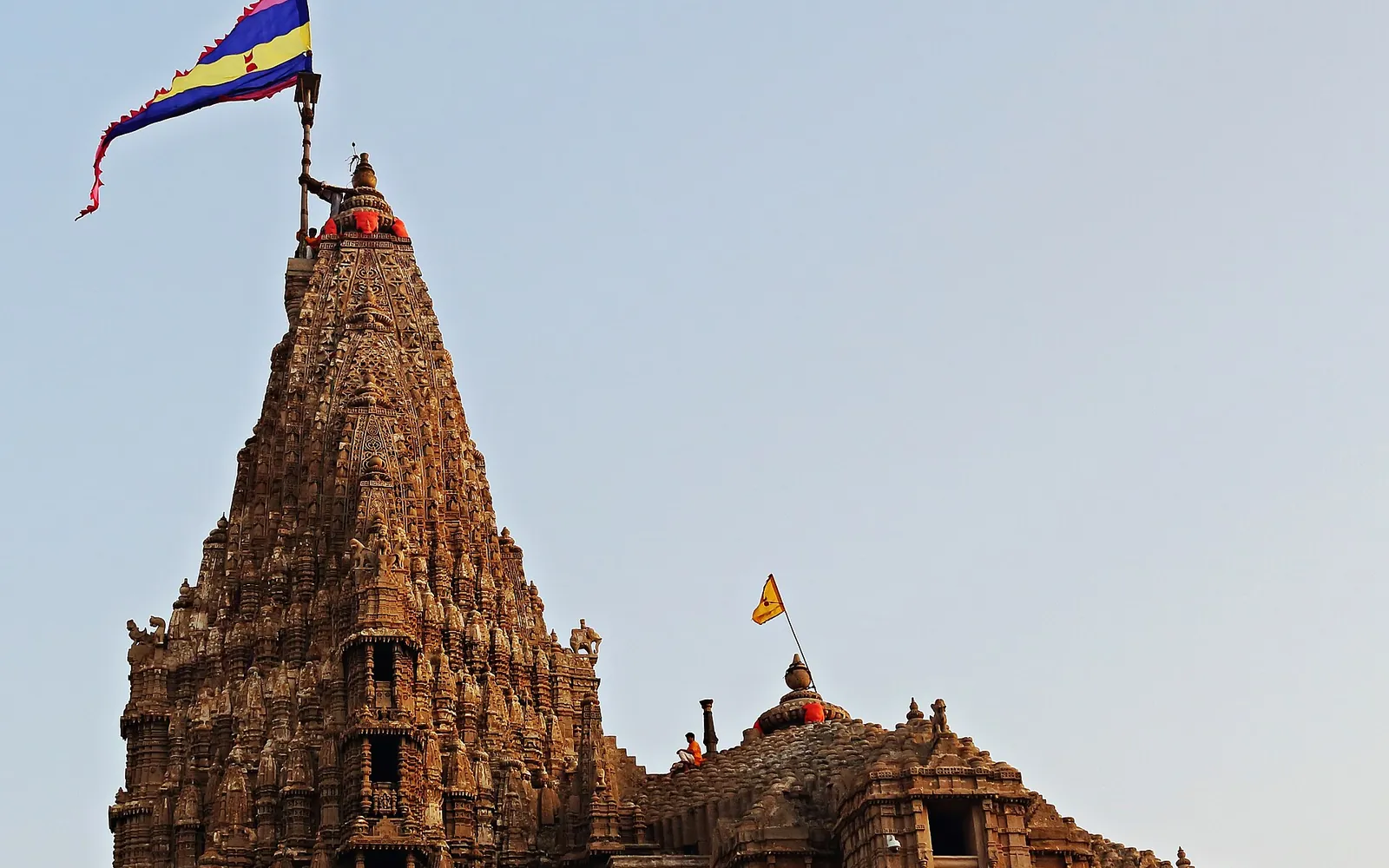
The queue at Dwarkadhish is not dead time if you approach it as part of the pilgrimage rather than as an obstacle to it. The outer courtyard and the approach lanes provide views of the main temple spire, the 5-storey, 43-metre Jagat Mandir tower, from several angles. The intricate carvings on the exterior walls of the temple can be observed in detail from the queue. The main spire features carvings of various divine figures and episodes from Krishna's life; standing in the queue gives you extended time with these carvings that a rushed walk past would not.
Chanting is the most natural activity for the waiting time. The Dwarkadhish Ashtakam, eight verses in praise of Dwarkadhish, is traditional to recite at this temple. Many pilgrims chant continuously through the queue. Group chanting is common and creates the kind of devotional atmosphere that is specific to shared pilgrimage. If you don't know the Ashtakam, the Hare Krishna mahamantra is equally appropriate and completely natural in this setting.
Smaller shrines within the outer temple complex can be visited while the queue moves slowly, there are shrines to Devki Mata, Rukmini Devi and other figures within the compound. Ask a temple volunteer about the inner shrines that can be visited without a separate queue; these are part of the complete darshan experience and most first-time visitors miss them entirely because they focus only on the main sanctum queue.
Fellow pilgrims are a resource. Long queues at major pilgrimage temples generate a particular kind of informal community, conversations happen, stories are shared, information about the temple and town is exchanged. Pilgrims who have visited many times are often happy to share knowledge about the best time for subsequent visits, lesser-known aspects of the temple, or other temples in the Dwarka area worth including in your yatra.
Is Darshan Worth the Long Queue?
The honest answer to this question comes back from virtually every pilgrim the same way: yes, and then some. The actual moment of darshan, 10 to 15 seconds in the busiest season, standing directly before the idol of Dwarkadhish, carries a weight that bears no proportion to its duration. Pilgrims who have stood in a 4-hour queue to reach that sanctum opening consistently describe the moment as erasing the wait entirely. This is not sentimentality, it is the reported experience of the place across centuries of pilgrimage.
Part of what makes the darshan at Dwarkadhish different from a museum visit or a tourist attraction is the accumulation of devotional energy in the space. Millions of pilgrims have stood where you stand. The priests have been performing rituals here continuously since the 16th century CE, with the temple's religious significance dating back to the ancient period described in the Mahabharata. The city of Dwarka is mentioned in the Srimad Bhagavatam, the Mahabharata, and the Skanda Purana. When you finally reach the sanctum after however many hours in the queue, you arrive at a place that has been the destination of pilgrims for longer than most nations have existed.
The atmosphere cannot be replicated. The sound of bells and conch shells at aarti time, audible from the queue. The smell of incense and marigold garlands. The sight of the dhwaja (flag) on the main spire, visible from several kilometres away. The feeling of the cool marble steps in the early morning. These sensory specifics, available only to those who actually make the journey and stand in the queue, are precisely why the pilgrimage to Dwarkadhish has not declined in the age of virtual tours and online content. You have to be there.
Frequently Asked Questions
Also Read
Dwarkadhish Temple
Complete guide to Dwarkadhish Temple, history, architecture, the 56 steps, Swarga Dwar, Moksha Dwar, and the idol of the four-armed Lord Krishna as King of Dwarka.
Read MoreTemple Timings & Aarti Schedule
Full daily schedule of Dwarkadhish Temple, opening times, five daily aartis, afternoon closure breaks, and the best aarti to attend as a first-time pilgrim.
Read MoreDwarkadhish VIP Darshan
What actually exists (and doesn't) around "VIP darshan" at Dwarkadhish Temple, plus honest tips for shortening your wait in the general queue.
Read More